
Ten years ago, making a digital payment in India often meant using a card, internet banking, or remembering bank-account details. Today, a smartphone and a QR code can be enough to pay for a cup of tea, groceries, a taxi ride, an online order, or a monthly bill.
At the centre of this transformation is UPI — Unified Payments Interface.
Launched by the National Payments Corporation of India (NPCI) under the regulatory oversight of the Reserve Bank of India (RBI), UPI has completed a decade of transforming India’s digital-payment ecosystem.
The UPI pilot was launched on 11 April 2016, while UPI-enabled apps began going live more broadly from 25 August 2016.
What started with a small group of banks has grown into one of the world’s largest real-time payment systems.
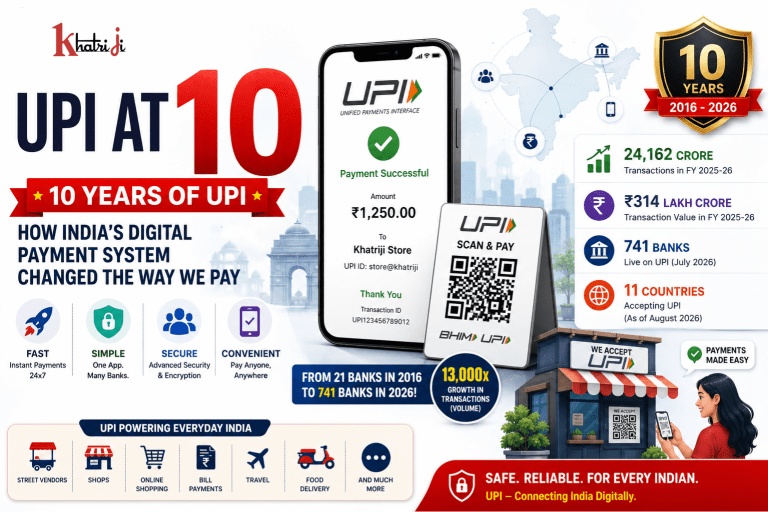
According to the Government of India’s latest 2026 data, UPI processed more than 24,162 crore transactions in FY 2025–26, with a total transaction value of around ₹314 lakh crore. As of July 2026, 741 banks were live on UPI.
So, how did UPI change the way India pays?
Let’s take a look at its journey, impact, benefits and what the future could look like.
What Is UPI?
UPI stands for Unified Payments Interface.
It is a real-time payment system that allows users to transfer money between participating bank accounts using a mobile application.
Instead of entering lengthy banking details for every transaction, users can often make payments using:
- UPI ID
- QR Code
- Mobile number
- Bank account
- Payment link
- UPI-enabled app
UPI can also bring multiple eligible bank accounts together within a single application, allowing users to access different banking services and make both person-to-person and merchant payments.
The result is a payment experience that is fast, convenient and highly interoperable.
How Did UPI Start?
Before UPI, India already had digital payment systems such as NEFT, RTGS and IMPS.
These systems were useful, but everyday digital payments could still involve different processes, banking credentials and payment interfaces.
NPCI developed UPI with the goal of creating a more unified and interoperable payment experience.
The UPI pilot was launched in Mumbai on 11 April 2016, with 21 banks participating at launch.
Later in August 2016, UPI-enabled applications began becoming available more broadly.
The system was designed to make instant bank-to-bank payments easier while also supporting merchant payments.
UPI at 10: From 21 Banks to 741 Banks
The growth of UPI over the last decade is remarkable.
At launch, only 21 banks were participating.
By July 2026, the number of banks live on UPI had increased to 741.
This expansion helped UPI become accessible to users across different parts of India and through a wide range of banking and payment applications.
It also helped create a common payment infrastructure where participating banks and payment providers could interact through an interoperable system.
UPI’s Incredible Growth in Numbers
The scale of UPI’s growth becomes clearer when we compare its early years with 2026.
| Metric | FY 2016–17 | FY 2025–26 |
|---|---|---|
| Annual transaction volume | 1.78 crore | 24,162 crore |
| Annual transaction value | ₹0.07 lakh crore | About ₹314 lakh crore |
| Banks live on UPI | 44 | 703 |
| UPI role | Emerging payment system | Major digital-payment infrastructure |
Official government data describes the increase in annual transaction volume as an almost 13,000-fold surge, while transaction value increased by nearly 4,000 times over the decade.
These numbers show that UPI did not simply become another payment option.
It became a major part of India’s everyday financial infrastructure.
Why Did UPI Become So Popular?
Several factors contributed to UPI’s rapid adoption.
1. Simple Payments
One of UPI’s biggest strengths is simplicity.
A typical QR payment can look like:
Scan → Enter Amount → Verify → Enter UPI PIN → Payment Complete
Users do not necessarily need to enter a card number, account number or IFSC code for every payment.
2. QR Code Payments
QR codes helped bring digital payments to businesses of all sizes.
Today, a QR code can be found at:
- Tea stalls
- Grocery stores
- Restaurants
- Petrol stations
- Medical shops
- Street vendors
- Shopping malls
- Service businesses
- Online businesses
A smartphone can effectively become a payment tool for both customers and merchants.
3. Instant Bank-to-Bank Transfers
UPI allows money to move between participating bank accounts in real time.
This makes it useful for:
- Sending money to family
- Paying friends
- Splitting restaurant bills
- Paying merchants
- Paying service providers
- Making online purchases
NPCI describes UPI as providing immediate money transfer through mobile devices, available around the clock.
4. No Need to Carry Cash Everywhere
UPI has reduced the need to carry cash for many everyday purchases.
A person going out for a short trip may only need:
Smartphone + Bank Account + UPI App
This has changed consumer behaviour, particularly for small-value transactions.
A ₹20 tea payment and a larger merchant transaction can both be completed through the same basic digital-payment process.
5. Multiple Banks Through One Interface
Another important feature is interoperability.
UPI allows users to access multiple participating bank accounts through supported UPI applications.
This means users are not necessarily restricted to a single bank’s payment ecosystem.
That interoperability has been one of the key reasons behind UPI’s scale.
How UPI Changed Small Businesses
UPI did not only change how customers pay.
It also changed how small businesses receive money.
Earlier, a small shop could primarily depend on:
- Cash
- Cheques
- Cards
Today, a QR code can allow a small merchant to accept digital payments without requiring customers to carry cash.
For merchants, UPI can provide:
- Faster payment confirmation
- Digital transaction records
- Reduced cash handling
- Easier payment collection
- Convenient customer experience
This has helped digital payments reach businesses far beyond traditional organised retail.
UPI and the Street Vendor Revolution
One of the most visible changes has happened at the smallest end of the market.
A roadside vendor, food stall or local service provider can display a QR code and accept digital payments.
This is significant because digital payments are no longer limited to:
Malls + Online Shopping + Large Businesses
They have become part of:
Local Shops + Small Businesses + Street Vendors + Everyday Services
That is one of the clearest examples of how digital public infrastructure can influence everyday economic activity.
UPI Changed the Way We Split Bills
Remember when splitting a restaurant bill meant collecting cash from everyone?
Today, one person can pay the restaurant and others can instantly send their share through UPI.
For example:
Restaurant Bill: ₹2,400
Four friends can simply send:
₹600 each
This is a small example, but it demonstrates how UPI has changed everyday financial behaviour.
UPI and Online Shopping
UPI has also become an important payment option for online businesses.
Customers can use UPI during checkout for:
- Shopping
- Food delivery
- Travel booking
- Hotel booking
- Bill payments
- Subscription services
- Online services
Instead of entering card details, users can often complete payment through a UPI app or payment interface.
This has made digital checkout easier for many consumers.
UPI and Bill Payments
UPI has become part of India’s broader digital-payment ecosystem.
Consumers can use digital payment platforms for:
- Electricity bills
- Mobile recharge
- Broadband
- DTH
- Water bills
- Insurance payments
- Loan repayments
- Other recurring expenses
The payment itself may take only a few seconds.
This convenience has contributed to the habit of making digital payments for routine expenses.
UPI Made Small-Value Digital Payments Normal
One of UPI’s biggest achievements is that it helped normalise small-value digital transactions.
Previously, consumers might hesitate to use a card for a very small purchase.
With QR-based UPI payments, a small transaction can be just as easy as a large one.
This helped digital payments move from occasional use to everyday use.
UPI’s Role in Financial Inclusion
UPI has also contributed to India’s broader financial-inclusion journey.
A smartphone and a bank account can provide access to digital payment infrastructure without requiring a traditional card terminal at every merchant location.
This can be especially useful for small businesses and consumers in areas where digital payment adoption is growing.
The government describes UPI as a critical driver of financial inclusion and digital public infrastructure.
UPI’s Growth in 2026
2026 has been another major year for UPI.
According to official data, monthly UPI transaction volume crossed 2,300 crore transactions for the first time in May 2026, reaching about 2,320 crore.
In July 2026, UPI recorded approximately 2,366 crore transactions, its highest monthly transaction volume at that point.
NPCI’s statistics also show more than 22.7 billion transactions in June 2026, with transaction value of about ₹28.92 lakh crore for the month.
This demonstrates that UPI’s growth did not stop after its first few years.
It continues to operate at an enormous scale.
UPI’s Global Expansion
UPI is no longer only an Indian payment story.
According to the Government of India, UPI was operational in 11 countries as of August 2026.
The system is increasingly being used as part of India’s cross-border digital-payment expansion.
This creates the possibility of easier payments for Indian travellers and greater connectivity between payment systems in participating countries.
Why UPI Is Important for Indian Travellers
For Indian travellers, international UPI acceptance can potentially make some payments easier.
Instead of depending entirely on:
- Cash
- International cards
- Currency exchange
travellers may be able to use supported UPI payment options where available.
However, international acceptance is not universal.
Users should always check:
- Whether UPI is supported in the destination
- Whether their bank/app supports the transaction
- Applicable currency conversion
- Any applicable charges
- Merchant acceptance
UPI Is More Than a Payment App
An important point is that UPI itself is not simply one app.
UPI is the underlying payment infrastructure.
Different banks and payment applications can use the UPI system to provide payment services.
This is why users can see UPI functionality across multiple apps and banks.
The UPI ecosystem includes users, merchants, banks, payment service providers and the NPCI infrastructure.
UPI vs Traditional Cash Payments
| Feature | Cash | UPI |
|---|---|---|
| Physical money required | Yes | No |
| Digital record | No | Yes |
| QR payment | No | Yes |
| Instant transfer | Physical handover | Yes |
| Available 24/7 | Depends on cash access | Yes |
| Suitable for online payments | No | Yes |
| Transaction history | Manual | Digital |
| Merchant acceptance | Physical cash | QR/app |
UPI has therefore become an important alternative to cash for everyday transactions.
UPI vs Cards
UPI and cards serve different purposes, but UPI has changed consumer expectations around payment convenience.
UPI
- QR payments
- Bank-account based
- UPI ID
- Mobile-based authentication
- Convenient for small everyday payments
Debit/Credit Cards
- Card number
- Expiry date
- CVV
- Card network
- Useful for online and offline transactions
- Credit cards can provide credit and rewards
Rather than completely replacing cards, UPI has expanded the digital-payment ecosystem and given consumers another highly convenient option.
UPI and Payment Security
Convenience must always be combined with security.
UPI uses authentication mechanisms designed to protect transactions, including two-factor authentication aligned with regulatory requirements.
However, users still need to protect themselves from fraud.
Important rules include:
Never Share Your UPI PIN
Your UPI PIN should remain private.
Don’t Approve Unknown Requests
Always check who is requesting money before approving a payment request.
Verify QR Codes
Before paying, check the recipient’s name and amount.
Be Careful With Refund Scams
You normally do not need to enter your UPI PIN simply to receive a refund.
Avoid Fake Customer-Care Numbers
Use official websites and applications to find customer support information.
<p>
As UPI becomes more widely used, payment security is also becoming increasingly important. Users should never share their UPI PIN or OTP with anyone. For more practical advice, read our guide on
UPI Safety Tips: How to Avoid Online Payment Fraud.
</p>
UPI Scams: Why Users Must Stay Alert
As digital payments become more popular, fraudsters also try to exploit them.
Common scams can include:
- Fake payment links
- Fake QR codes
- Fake customer-care numbers
- Screen-sharing scams
- Phishing messages
- Fake cashback offers
- Fake KYC updates
- Payment-request scams
The basic rule is simple:
You should never share your UPI PIN, OTP, card PIN or banking password with anyone.
How UPI Changed Consumer Behaviour
UPI did more than introduce a new payment method.
It changed expectations.
Consumers now expect payments to be:
Fast
Simple
Available 24/7
Mobile-first
Easy to track
Convenient
This has influenced the wider financial-services industry.
Banks, fintech companies and merchants increasingly compete around payment convenience, digital experiences and instant transactions.
UPI and the Rise of the Smartphone Wallet
A decade ago, a wallet often meant:
Cash + Cards
Today, for many consumers, a smartphone can provide access to:
- Bank accounts
- UPI
- Digital payments
- Recharge
- Bill payments
- Shopping
- Travel bookings
- Financial services
This is why UPI has been described by government officials as part of a transformation where the phone has effectively become the wallet for everyday payments.
What Made UPI Different?
Several characteristics helped UPI stand out.
Interoperability
Different participating banks and apps can operate within a common payment ecosystem.
Real-Time Payments
Money can move quickly between participating accounts.
QR-Based Payments
Merchants can accept payments through QR codes.
Mobile-First Experience
Payments can be initiated through smartphones.
24/7 Availability
UPI is designed for round-the-clock payments.
Easy Merchant Acceptance
QR-based acceptance made digital payments accessible to many small businesses.
The UPI Journey: Important Milestones
2016 — UPI Launch
UPI’s pilot was launched in April 2016.
August 2016 — UPI Goes Live
UPI-enabled apps began becoming available more broadly from August 2016.
December 2016 — BHIM
The BHIM app was launched, helping bring UPI-based payments to a wider audience.
2018 — UPI 2.0
NPCI launched UPI 2.0 with additional capabilities.
2019 — IPO Mandate
UPI expanded into IPO applications with One-Time Mandate functionality.
2020s — Rapid Adoption
UPI became increasingly integrated into online commerce and everyday retail payments.
2026 — Ten Years of UPI
UPI completed its first decade, with more than 24,000 crore annual transactions in FY 2025–26 and hundreds of participating banks.
UPI’s Biggest Achievement: Making Digital Payments Ordinary
Perhaps UPI’s biggest achievement is not simply the number of transactions.
It is the fact that digital payment became ordinary.
A customer doesn’t necessarily think:
“I am making a digital financial transaction.”
They simply think:
“I’ll scan the QR code.”
That behavioural change is extremely important.
Digital payment became part of everyday life.
Challenges for the Next 10 Years
Despite its success, UPI will face new challenges.
1. Fraud Prevention
As transaction volumes grow, preventing scams and fraud becomes increasingly important.
2. Cybersecurity
The payment infrastructure must remain resilient against increasingly sophisticated cyber threats.
3. System Reliability
With billions of transactions, uptime and reliability are critical.
4. International Expansion
Cross-border payment systems require coordination between countries and financial institutions.
5. Financial Sustainability
The ecosystem needs sustainable models to support infrastructure, innovation and security while keeping digital payments accessible.
6. Digital Literacy
Users need better awareness of payment scams and cybersecurity.
What Could UPI Look Like in the Future?
The next decade could bring even more changes.
Potential areas of development include:
- More international UPI acceptance
- Better fraud detection
- AI-powered payment security
- Faster dispute resolution
- Greater merchant adoption
- More digital financial services
- Better accessibility
- Wider rural adoption
- New payment experiences
- Greater integration with financial products
The exact direction will depend on technology, regulation, consumer behaviour and the needs of the payment ecosystem.
UPI at 10: Key Statistics
According to the latest official 2026 data:
| UPI Milestone | 2026 Position |
|---|---|
| Years completed | 10 |
| FY 2025–26 transaction volume | 24,162 crore |
| FY 2025–26 transaction value | About ₹314 lakh crore |
| Banks live on UPI in July 2026 | 741 |
| Record monthly volume in July 2026 | 2,366 crore |
| Countries accepting UPI | 11 |
| Share of global real-time payment volume | About 49% in 2025 |
| Share of India’s digital payments | About 84% in FY 2025–26 |
Frequently Asked Questions About UPI
What is UPI?
UPI stands for Unified Payments Interface. It is an interoperable real-time payment system developed by NPCI that allows users to make bank-account-based payments through supported applications.
When was UPI launched?
The UPI pilot was launched on 11 April 2016. UPI-enabled applications began going live more broadly from August 2016.
Who developed UPI?
UPI was developed by the National Payments Corporation of India (NPCI) under the regulatory oversight of the Reserve Bank of India.
How many banks are on UPI in 2026?
As of July 2026, 741 banks were live on UPI according to the Government of India’s 10-year UPI update.
How many UPI transactions happened in FY 2025–26?
UPI processed more than 24,162 crore transactions in FY 2025–26.
What was the value of UPI transactions in FY 2025–26?
The total value was approximately ₹314 lakh crore.
Is UPI available outside India?
Yes. As of August 2026, UPI was operational in 11 countries, according to the Government of India.
Is UPI safe?
UPI incorporates security mechanisms including two-factor authentication, but users must still protect their UPI PIN, OTP and banking credentials and remain alert to scams.
Can UPI be used for merchant payments?
Yes. UPI supports both person-to-person and merchant payments.
Conclusion
In just ten years, UPI has changed India’s relationship with money.
What began in 2016 with a small number of banks has grown into a payment ecosystem processing tens of thousands of crore transactions every year.
From a roadside tea stall to a large online business, from splitting a restaurant bill with friends to paying household bills, UPI has made digital payments faster and more accessible.
The numbers tell the story:
24,162 crore transactions in FY 2025–26.
Around ₹314 lakh crore in transaction value.
741 banks live on UPI as of July 2026.
11 countries accepting UPI.
But the real story of UPI is not only about transaction numbers.
It is about a change in behaviour.
Cash became optional.
QR codes became normal.
Smartphones became payment tools.
Digital payments became part of everyday life.
As UPI enters its next decade, the focus will increasingly be on security, reliability, innovation, international expansion and financial inclusion.
The first ten years transformed how India pays.
The next ten years could determine how India—and potentially other countries—build the future of digital payments.
UPI at 10: From a payment innovation to a part of everyday India.
Khatriji — One App, Many Services.
Tags: Digital India, digital payments, Financial Awareness, Fintech, khatriji, Online Payments, UPI, UPI 10 Years, UPI 2026, UPI History