
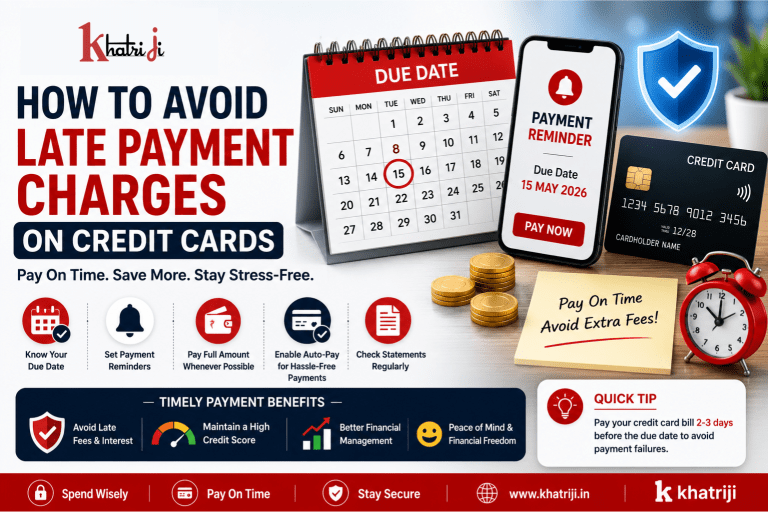
Credit cards can make everyday spending, online shopping and bill payments more convenient. However, missing your credit card payment due date can result in late payment charges, interest and other financial consequences.
The good news is that avoiding late payment charges does not have to be difficult. With a few simple habits—such as tracking your due date, setting reminders, paying the full amount on time and checking your statement regularly—you can manage your credit card more effectively.
In this guide, we explain how to avoid late payment charges on credit cards, how the payment due date works, why paying only the minimum amount can be expensive, and how timely payments can help you maintain better financial discipline.
Important: Credit card fees, interest rates and payment rules can vary by card issuer. Always check your card’s latest terms, statement and Most Important Terms and Conditions (MITC).
What Are Credit Card Late Payment Charges?
A late payment charge is a fee that a credit card issuer may apply when required payment obligations are not met within the applicable period.
The exact fee depends on the card issuer, card type and outstanding amount.
Your credit card statement normally provides important information such as:
- Total amount due
- Minimum amount due
- Payment due date
- Applicable interest rate
- Late payment charges
- Other applicable fees and charges
RBI directions require card issuers to disclose late-payment charges and the method of calculating them in their card documentation and billing statements.
Why Is Paying Your Credit Card Bill on Time Important?
Paying your credit card bill on time can help you:
- Avoid applicable late payment charges
- Reduce the risk of additional interest costs
- Maintain better control over your outstanding balance
- Avoid unnecessary financial stress
- Build consistent repayment habits
- Protect your credit profile from avoidable payment problems
A missed payment can become more expensive if the outstanding balance continues to remain unpaid.
1. Always Know Your Credit Card Due Date
The first step to avoiding late payment charges is simple:
Know your payment due date.
Your due date is generally shown clearly on your monthly credit card statement.
Don’t rely only on memory.
Check your:
- Credit card statement
- Banking app
- SMS alerts
- Email statement
- Card issuer’s website
Make a habit of checking the due date as soon as your monthly statement is generated.
2. Set a Payment Reminder
One of the easiest ways to avoid missing a payment is to set a reminder.
You can use:
- Mobile calendar
- Alarm
- Banking notification
- Email reminder
- Personal finance app
- Digital task manager
For example, if your credit card payment is due on the 20th, create reminders several days before the due date.
This gives you enough time to arrange funds and complete the payment.
3. Don’t Wait Until the Last Minute
Even if you know the due date, making the payment at the last possible moment can create unnecessary risk.
Technical issues, banking delays, payment failures or incorrect payment details could prevent timely completion.
A better approach is to pay before the due date.
For example:
Due date: 20th
Instead of waiting until the 20th evening, consider completing the payment earlier.
This gives you additional time to resolve any unexpected issue.
4. Pay the Full Amount Due Whenever Possible
Your statement may show both:
Total Amount Due
and
Minimum Amount Due
These are not the same thing.
If financially possible, paying the total amount due by the due date is generally preferable because carrying a balance can lead to interest costs and can reduce the benefit of an interest-free credit period.
RBI directions require card issuers to clearly explain the implications of paying only the minimum amount due, including the possibility that repayment can stretch over months or years with consequential interest.
5. Understand the Minimum Amount Due
The Minimum Amount Due (MAD) is the minimum payment specified by the card issuer that you need to pay according to your statement.
However, paying only the minimum amount does not necessarily mean that the remaining balance is interest-free.
If you don’t clear the total amount due, the interest-free credit period can be lost and interest may apply to the outstanding amount according to your card’s terms. RBI guidance specifically requires issuers to warn customers about the consequences of making only minimum payments.
Example
Suppose your statement shows:
- Total amount due: ₹30,000
- Minimum amount due: ₹1,500
- Due date: 20 August
Paying ₹1,500 may satisfy the minimum-payment requirement, but it does not mean the remaining ₹28,500 is free of interest.
Always read your card issuer’s terms carefully.
6. Use Auto-Pay Carefully
Many banks and card issuers provide automatic payment or standing-instruction facilities.
Depending on the options provided by your issuer, you may be able to configure automatic payment toward your credit card bill.
Auto-pay can help reduce the risk of forgetting a due date.
However, you should still:
- Maintain sufficient funds
- Check the payment status
- Review your statement
- Verify the amount debited
- Monitor failed payment notifications
Auto-pay is a convenience, not a replacement for checking your account.
7. Keep Enough Money Available for Payment
If you use automatic payment or plan to pay from your bank account, make sure sufficient funds are available.
A payment can fail because of:
- Insufficient balance
- Incorrect account details
- Bank-related technical issues
- Payment-system issues
- Card or account restrictions
Maintaining adequate funds before the due date can reduce the risk of failed payments.
8. Check Your Credit Card Statement Every Month
Don’t simply pay your bill without reviewing the statement.
Check:
- Total amount due
- Minimum amount due
- Due date
- Recent transactions
- Refunds
- Reversed transactions
- EMI charges
- Applicable fees
- Interest
- Previous outstanding amount
Regular statement review can help you detect errors or unexpected transactions early.
9. Pay Attention to Refunds and Reversed Transactions
Sometimes a refund or reversed transaction may be credited to your card account.
Don’t assume that a refund automatically means your entire bill is paid.
Check your latest statement and confirm:
- Refund amount
- Adjusted outstanding balance
- Total amount due
- Remaining amount payable
- Due date
RBI directions state that interest calculations should account for payments, refunds and reversed transactions when determining the outstanding amount.
10. Keep Your Payment Confirmation
After making a credit card payment, keep the confirmation.
You may receive:
- SMS confirmation
- Email confirmation
- Transaction reference number
- Payment receipt
- Banking-app confirmation
Keeping the confirmation can be useful if you later need to investigate a payment-status issue.
11. Check Payment Status After Paying
Don’t assume that a payment was successful simply because you clicked the payment button.
After making the payment, verify:
- Payment status
- Transaction reference
- Amount
- Date
- Credit card outstanding balance
If the payment failed, take appropriate action before the due date whenever possible.
12. Don’t Confuse Statement Date With Due Date
Two dates can be important:
Statement Date
The date on which your billing statement is generated.
Payment Due Date
The date by which the required payment should be made.
These dates are different.
Always look specifically for the Payment Due Date on your statement.
13. Avoid Paying Only After Receiving a Reminder
Don’t depend on the bank to remind you that a payment is due.
Payment reminders can be useful, but your own tracking system should be the primary method.
A simple monthly routine can help:
Statement received → Check amount → Note due date → Arrange funds → Pay → Confirm payment
14. Keep Your Contact Details Updated
Make sure your card issuer has your current:
- Mobile number
- Email address
- Communication preferences
This helps you receive relevant statements and alerts.
RBI directions require card issuers to ensure bills/statements are sent without delay and provide customers sufficient time for payment before interest starts being charged.
15. Don’t Ignore a Payment You Cannot Afford
If you realize that you may not be able to make your required payment, don’t simply ignore the situation.
Contact your card issuer through an official channel and understand the available options.
Depending on the issuer and your circumstances, options may vary.
The important thing is to address the problem early rather than allowing the balance to remain unpaid without understanding the consequences.
Does a Three-Day Rule Mean You Can Always Pay Late?
This is an important point.
RBI’s current directions for credit cards provide that a card account is reported as “past due” to credit information companies or penal charges such as late-payment charges may be levied only when the account remains past due for more than three days. However, the number of days past due and late-payment charges are computed from the payment due date specified in the statement.
This should not be treated as permission to routinely pay late.
Your safest strategy is still:
Pay the required amount on or before the stated due date.
Also, card issuers can have specific terms and conditions, and other consequences may apply when balances remain unpaid.
Can Late Payment Charges Be Applied to the Entire Bill?
RBI directions specify that late-payment charges and related charges are to be levied on the outstanding amount after the due date, rather than the total amount due.
However, the exact calculation and amount of applicable charges depend on the card issuer’s terms.
Always check your card’s MITC and statement for the applicable fee structure.
What Happens If You Miss Your Credit Card Payment?
Depending on the circumstances and card issuer, missing or delaying payment can lead to:
1. Late Payment Charges
Applicable late fees may be charged according to the card’s terms.
2. Interest
Interest may apply to outstanding amounts depending on the payment made and the issuer’s terms.
3. Loss of Interest-Free Period
If the total amount due isn’t cleared, the interest-free credit period may be affected.
4. Credit Reporting Consequences
Persistent overdue status can have implications for credit reporting. RBI rules govern when a card account can be reported as past due.
5. Higher Outstanding Balance
Late fees and interest can increase the amount you eventually need to repay.
How to Build a Simple Credit Card Payment Routine
A simple routine can make credit card management easier.
Every Month
Step 1
Check your statement.
Step 2
Note the total amount due.
Step 3
Note the minimum amount due.
Step 4
Mark the payment due date.
Step 5
Review your transactions.
Step 6
Arrange sufficient funds.
Step 7
Make the payment early.
Step 8
Check payment confirmation.
Step 9
Verify that the outstanding balance has updated appropriately.
This routine can help reduce accidental missed payments.
How Khatriji Can Fit Into Your Digital Payment Routine
Khatriji provides digital payment-related services, and users should always verify the applicable service availability and payment details before completing a transaction.
When using any digital payment platform:
- Verify the biller or service
- Check the amount
- Confirm the payment details
- Use secure payment methods
- Keep the transaction confirmation
- Check the payment status after completion
Most importantly, never share confidential credentials such as your OTP, UPI PIN, card PIN or banking password with another person.
10 Quick Tips to Avoid Credit Card Late Payment Charges
- Know your due date.
- Set multiple reminders.
- Pay before the last day.
- Pay the total amount due whenever possible.
- Understand your minimum amount due.
- Keep sufficient funds available.
- Use auto-pay if suitable for you.
- Check your statement every month.
- Confirm every payment successfully.
- Contact your card issuer early if you expect difficulty paying.
Credit Card Payment Checklist
Before the due date, ask yourself:
-
Have I checked my latest statement?
-
Do I know my payment due date?
-
Have I checked the total amount due?
-
Have I checked the minimum amount due?
-
Do I have sufficient funds?
-
Have I reviewed recent transactions?
-
Is auto-pay active, if I use it?
-
Have I made the payment?
-
Did I receive payment confirmation?
-
Have I checked the payment status?
Frequently Asked Questions
What is the easiest way to avoid credit card late payment charges?
The simplest approach is to know your due date, set reminders and pay the required amount on time. If financially possible, paying the total amount due is generally preferable to carrying a balance.
Is paying the minimum amount due enough?
It may satisfy the minimum-payment requirement specified by the card issuer, but it does not necessarily prevent interest from accumulating on the remaining balance. Paying only the minimum can also make repayment take much longer.
Should I pay my credit card bill before the due date?
Yes. Paying before the due date can give you additional time to deal with a failed or delayed payment.
Can I use auto-pay for my credit card?
If your card issuer offers it, auto-pay can be useful for reducing the chance of forgetting a payment. Make sure sufficient funds are available and continue checking your statements and payment status.
What should I do if my payment fails?
Check the payment status and contact your card issuer or payment provider through an official channel. If the due date has not passed, make another valid payment as soon as possible.
What if I accidentally miss my credit card due date?
Check your card issuer’s current terms and contact the issuer if necessary. Make the required payment as soon as possible and retain the transaction confirmation.
Does paying late always mean a credit-score problem?
Not every short delay automatically produces the same credit-reporting outcome. RBI rules specify when an account may be reported as “past due,” while persistent overdue payments can have more serious consequences.
How can I check whether my credit card payment was successful?
Check your banking/payment application, transaction reference, SMS or email confirmation, and the card account’s outstanding balance.
Can Khatriji help with credit card bill payment?
Khatriji offers digital payment-related services. Service availability and supported billers can change, so users should check the current options directly on the Khatriji website before making a payment.
Conclusion
Avoiding late payment charges on credit cards is mainly about consistency and planning.
Know your due date, check your statement, set reminders, keep sufficient funds available and complete your payment before the deadline. Whenever financially possible, clearing the total amount due can also help you avoid carrying an expensive outstanding balance.
Don’t rely on memory alone. Build a simple monthly payment routine and always verify that your payment was successfully processed.
For digital payments, use trusted channels, verify the recipient and amount, and never share confidential payment credentials.
Pay on time, check your statement regularly and use your credit card responsibly.
Tags: Credit Card, Credit Card Bill Payment, Credit Card Bill Payment Online, Credit Card Due Date, Credit Card Interest, Credit Card Late Fees, Credit Card Late Payment Charges, Credit Card Minimum Due, Credit Card Payment, Credit Card Payment Online, digital payments, khatriji, Khatriji Credit Card Payment, online bill payment, Payment Tips