
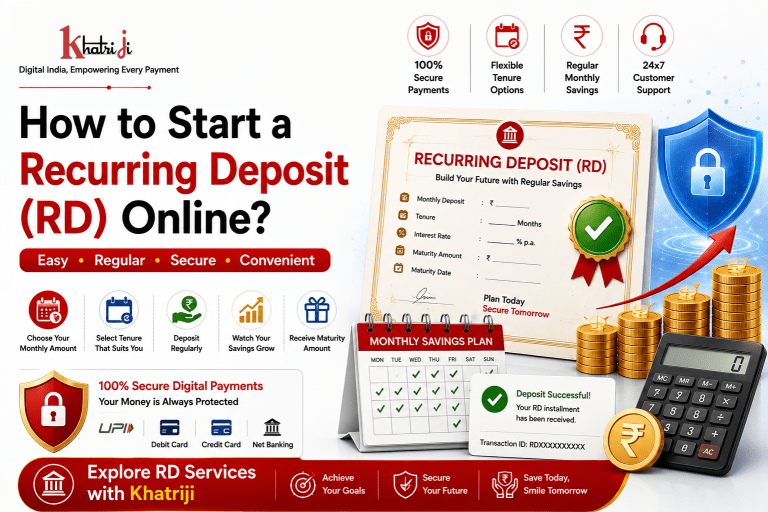
Saving money regularly is an important part of financial planning. For people who want to set aside a fixed amount every month, a Recurring Deposit (RD) can be a useful savings option.
A Recurring Deposit allows you to deposit a predetermined amount at regular intervals, generally every month, for a selected tenure. At maturity, the deposited amount may be paid along with applicable interest according to the terms and conditions of the bank or financial institution.
With Khatriji, users can access various digital payment and financial services. If a supported RD service is available through Khatriji, customers should check the applicable provider, eligibility, interest rate, tenure and terms before proceeding.
In this guide, we will explain what an RD is, how it works, its benefits, how to start an RD online, what information may be required and what you should check before making an RD payment.
What Is a Recurring Deposit?
A Recurring Deposit, commonly known as an RD, is a savings product where you deposit a fixed amount regularly for a predetermined period.
For example, suppose you choose:
- Monthly deposit: ₹2,000
- Tenure: 24 months
Your total principal contribution would be:
₹2,000 × 24 = ₹48,000
The applicable maturity amount would depend on the interest rate and calculation method offered by the respective bank or financial institution.
Note: The above example is for illustration only. Actual maturity amounts, interest rates and applicable charges depend on the provider’s current terms.
How Does a Recurring Deposit Work?
The basic RD process is simple:
Choose Monthly Amount → Select Tenure → Make Regular Deposits → Complete Tenure → Receive Maturity Amount
When opening an RD, you generally select:
- The amount you want to deposit regularly.
- The RD tenure.
- The applicable interest rate.
- The payment schedule.
- The account or provider through which the RD is maintained.
The provider then calculates the applicable interest and maturity amount according to its rules.
Benefits of Recurring Deposit
1. Encourages Regular Savings
An RD can help create a disciplined monthly saving habit because you commit to depositing a fixed amount regularly.
2. Useful for Financial Goals
Regular deposits can be used for planning toward goals such as:
- Education expenses
- Travel
- Annual expenses
- Festival expenses
- Emergency savings
- Other planned financial requirements
3. Fixed Tenure
You generally select the tenure when opening the RD, making it easier to plan your savings period.
4. Predictable Monthly Contribution
You know the amount that needs to be deposited according to your selected RD plan.
5. Maturity Benefit
At the end of the selected tenure, you may receive the accumulated deposits along with applicable interest according to the provider’s terms.
How to Start a Recurring Deposit Online?
If a supported RD service is available through Khatriji, the general process may involve the following steps.
Step 1: Visit Khatriji
Download the Khatriji app or open the website according to your device:
- Android App: Click here to download the Khatriji app.
- Ios App (Apple): Click here to download the Khatriji app.
- Website: Click here to open the Khatriji website.
Step 2: Find the Available RD Service
Check the currently available financial services and look for Recurring Deposit or RD.
Because service availability can change, always verify that the service is currently available before proceeding.
Step 3: Select the Supported Provider
If multiple providers are available, select the relevant bank or financial institution.
Step 4: Enter the Required Information
Depending on the provider, you may need information such as:
- Customer ID
- Account Number
- Registered Mobile Number
- Date of Birth
- PAN or KYC information
- RD account details
- Other provider-specific information
The exact requirements can vary between providers.
Step 5: Select Your RD Details
Review the available options, including:
- Monthly deposit amount
- Tenure
- Applicable interest rate
- Maturity date
- Payment schedule
- Applicable charges
Step 6: Verify the Details
Before completing the transaction, carefully check:
- Provider name
- Customer information
- Deposit amount
- Tenure
- Interest rate
- Maturity information
- Payment details
Step 7: Complete the Payment
Use the payment method provided during the transaction.
Available payment methods can vary depending on the service and payment gateway.
Step 8: Save the Confirmation
After a successful payment or RD setup, keep the relevant:
- Transaction ID
- Payment Reference
- Receipt
- RD Reference Number
- Confirmation message
for future reference.
What Information Is Required for an RD?
The required information depends on the bank or financial institution.
You may be asked for:
- Customer ID
- Bank account details
- Registered mobile number
- PAN details
- KYC information
- Monthly deposit amount
- RD tenure
- Nominee information
- Other provider-specific details
Always enter your information only through an authorized and secure payment or account-opening process.
How Much Should You Deposit in an RD?
The right monthly RD amount depends on your income, expenses and financial goals.
Before selecting an amount, consider:
- Monthly income
- Household expenses
- Existing EMIs
- Emergency savings
- Other investments
- Upcoming financial requirements
Choose an amount that you can comfortably maintain throughout the selected tenure.
For example, if your monthly budget allows you to save ₹2,000 comfortably, you may consider an RD amount around that level rather than choosing an amount that puts pressure on your monthly finances.
Recurring Deposit vs Savings Account
| Feature | Recurring Deposit | Savings Account |
|---|---|---|
| Main purpose | Regular savings | Everyday banking |
| Deposit pattern | Regular deposits | Flexible deposits |
| Tenure | Usually selected | Generally no fixed tenure |
| Interest | Provider’s applicable RD rate | Savings account rate |
| Withdrawal | Subject to RD terms | Generally more flexible |
| Goal-based saving | Useful | Less structured |
Both products serve different purposes, so the appropriate option depends on your financial requirements.
Recurring Deposit vs Fixed Deposit
RD and FD are both commonly used savings products, but their deposit structures are different.
| Feature | Recurring Deposit | Fixed Deposit |
|---|---|---|
| Deposit method | Regular installments | Usually one-time deposit |
| Monthly contribution | Yes | No |
| Tenure | Selected tenure | Selected tenure |
| Interest | Provider’s applicable rate | Provider’s applicable rate |
| Maturity | Deposits + applicable interest | Principal + applicable interest |
The actual interest calculation, tenure options and premature closure rules depend on the provider.
What Should You Check Before Starting an RD?
Before opening or paying for an RD, carefully review the provider’s terms.
Check the Interest Rate
Interest rates can vary based on the provider, tenure and customer category.
Check the Tenure
Make sure the selected tenure matches your financial goal.
Check the Monthly Installment
Confirm how much you will need to deposit regularly.
Check the Maturity Amount
If the provider displays an estimated maturity amount, verify the calculation and applicable assumptions.
Check Premature Closure Rules
Understand what happens if you need to close the RD before maturity.
Check Missed Installment Rules
Find out whether late or missed installments may result in penalties or other consequences.
What Happens If an RD Installment Is Missed?
The consequences depend on the provider’s terms.
Depending on the RD product, a missed installment may result in:
- Late payment charges
- Penalties
- Interest-related adjustments
- Other account-specific consequences
Therefore, check the provider’s missed-installment policy before starting the RD.
Can You Close an RD Before Maturity?
Some RD products may allow premature closure, but the conditions vary by provider.
Premature closure may affect:
- Interest calculation
- Maturity amount
- Applicable charges
- Other benefits
Always review the provider’s premature-closure terms before making a decision.
Is Recurring Deposit Safe?
An RD offered by a regulated bank or financial institution is a formal savings product, but the applicable protections depend on the institution and product.
Before opening an RD:
- Verify the provider.
- Check the current interest rate.
- Read the terms and conditions.
- Understand premature closure rules.
- Review applicable deposit insurance or regulatory protections.
- Keep your account and payment records safe.
Do not make decisions based only on advertised returns. Review the complete product terms.
Online RD Payment Security Tips
If you are making an RD payment online, follow basic digital payment security practices.
Never Share Your OTP
An OTP should only be entered by you through the authorized payment interface.
Never Share Your UPI PIN
Never disclose your UPI PIN to anyone.
Protect Your Passwords
Do not share banking, account or Khatriji login credentials.
Verify the Amount
Always check the amount before approving the transaction.
Verify the Provider
Make sure you are paying the correct bank or financial institution.
Save Your Transaction Reference
Keep the transaction ID or receipt after payment.
What If Your RD Payment Fails?
If your payment fails, do not immediately make another payment without checking the first transaction.
Follow these steps:
- Check the payment status.
- Check whether your bank account was debited.
- Save the transaction reference.
- Verify the RD/provider details.
- Wait for the applicable processing period if the status is pending.
- Contact the relevant support channel if the issue remains unresolved.
This can help prevent duplicate payments.
What If Money Is Debited but the RD Is Not Updated?
Sometimes a payment may be debited from your bank account while the service status remains pending.
In such a situation:
- Check the transaction status.
- Keep the transaction ID ready.
- Verify the payment confirmation.
- Check the amount that was debited.
- Allow the applicable processing time.
- Contact the relevant support team if the status does not update.
Avoid making a second payment until the first transaction has been properly checked.
Why Use Khatriji for Digital Payments?
Khatriji provides digital recharge and bill-payment services through its online platform.
Depending on the services currently available, users may be able to manage different types of digital payments from one platform.
For any specific RD service, however, you should first verify that the relevant Recurring Deposit service and provider are currently available on Khatriji.
If a dedicated RD service page becomes available, the exact Khatriji URL should be used for internal linking rather than creating an unverified URL.
Frequently Asked Questions
What is a Recurring Deposit?
A Recurring Deposit is a savings product where you deposit a predetermined amount regularly for a selected tenure and receive the accumulated amount with applicable interest according to the provider’s terms.
Is RD better than a savings account?
It depends on your financial goal. RD is designed for structured regular savings, while a savings account generally provides more flexibility for everyday transactions.
Can I start an RD online?
Many banks and financial institutions provide online RD facilities. Availability and account-opening requirements depend on the provider.
Can I pay my RD installment online?
Where online payment is supported, an RD installment can be paid using the payment methods provided by the relevant service.
What is the minimum RD amount?
The minimum deposit amount depends on the bank or financial institution and the specific RD product.
Can I change my monthly RD amount?
This depends on the specific RD product. Check the provider’s terms before opening the account.
What happens if I miss an RD installment?
The provider may apply a penalty, late charge or other conditions. Check the specific RD terms.
Can I close an RD before maturity?
Some providers allow premature closure, but interest and other terms may be affected.
Does Khatriji provide an RD service?
You should verify the current Khatriji service listing before publishing a claim that RD is an active Khatriji service. If you have a dedicated Khatriji RD service URL, use that exact URL in the article.
Conclusion
A Recurring Deposit can be a convenient way to build a regular savings habit by depositing a fixed amount over a selected period.
Before starting an RD, compare the monthly deposit, tenure, applicable interest rate, maturity amount, missed-installment rules and premature-closure conditions.
If you want to use Khatriji for an RD-related payment or service, first confirm that the relevant RD service and provider are currently supported.
Tags: Digital Financial Services, khatriji, Khatriji RD Service, Khatriji Recurring Deposit, Monthly Deposit, Monthly Savings, Online Financial Services, Online RD Payment, RD, RD Account, RD Interest Rate, RD Maturity, RD Online, RD Payment, RD Savings, Recurring Deposit, Recurring Deposit Benefits, Recurring Deposit India, Recurring Deposit Online, Recurring Deposit Online India