
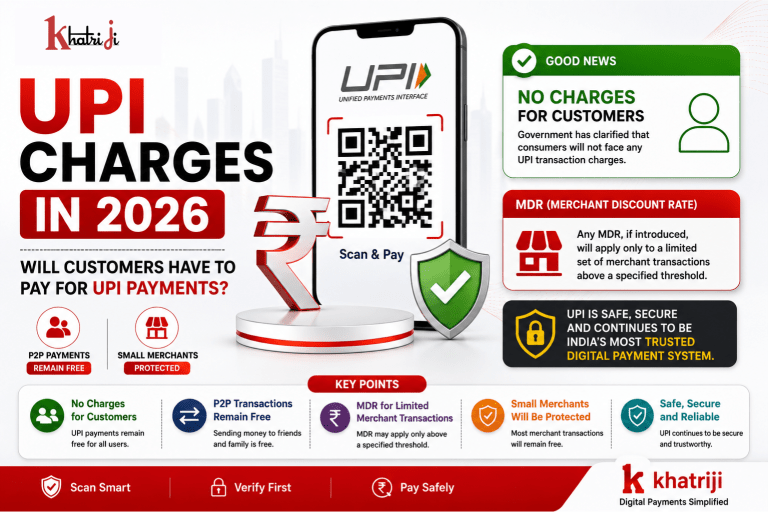
UPI Charges 2026 are a major topic for customers and merchants using digital payments in India. Will customers have to pay an additional charge for UPI payments? This guide explains MDR, the ₹2,000 transaction threshold, P2P payments, and merchant charges in simple terms.
These questions have become important for millions of Indians because UPI is now part of everyday life—from paying at local shops and restaurants to paying bills, booking services and sending money to family members.
The latest clarification from the Government of India is important: consumers will not have to pay transaction charges for using UPI. Person-to-person (P2P) UPI transactions will also remain free. The government has said that any MDR, if introduced, would apply only to a limited set of merchant transactions above a specified threshold.
So, does this mean UPI is completely free for everyone in every situation? Not necessarily. The discussion is mainly about how the UPI ecosystem may recover costs from certain merchant transactions—not about charging ordinary customers for using UPI.
Let’s understand the issue in simple terms.
What Is UPI?
UPI, or Unified Payments Interface, is India’s instant digital payment system that allows users to transfer money directly between bank accounts through supported payment applications.
UPI can be used for:
- Sending money to another person
- Paying merchants
- QR Code payments
- Online shopping
- Bill payments
- Travel bookings
- Service payments
- Recurring payments
- Other digital transactions
UPI has grown dramatically since its launch in 2016 and is now one of the world’s largest real-time payment systems. In July 2026 alone, UPI processed around 2,366 crore transactions worth ₹29.9 lakh crore, according to the Finance Minister’s August 2026 clarification.
Is UPI Free for Customers in 2026?
Yes.
As of the latest Government of India clarification, customers making UPI payments will not face transaction charges for using UPI.
The government has specifically stated:
- Consumers will not face transaction charges.
- Person-to-person transactions will remain free.
- Any MDR introduced would apply only to a limited set of merchant transactions.
- Small merchants are intended to remain protected from such charges.
Therefore, if you use UPI to:
- Send ₹500 to a friend
- Pay ₹200 at a shop
- Pay a utility bill
- Make an eligible online purchase
- Pay for a service
you should not assume that a new UPI customer charge has been introduced simply because there is discussion about MDR.
Then Why Are People Talking About UPI Charges?
The confusion comes from the term MDR.
MDR stands for Merchant Discount Rate.
It is a fee associated with processing certain merchant payments and is generally paid within the merchant payment ecosystem rather than being a direct fee charged to the customer.
The recent policy discussion is about creating the legal ability to introduce MDR for certain UPI merchant transactions.
That is very different from saying:
“Every person using UPI will have to pay a transaction fee.”
The Government has explicitly clarified that consumers will not be charged for using UPI.
What Is MDR?
Merchant Discount Rate (MDR) is a payment-processing fee associated with certain merchant transactions.
For example, when a customer pays a business digitally, different participants may be involved:
Customer → UPI App → Payment Service Provider/Bank → Merchant Bank → Merchant
The payment ecosystem requires infrastructure, technology, security, processing and settlement systems.
MDR, where applicable, is one mechanism through which costs can be recovered.
Historically, the government made MDR zero for BHIM-UPI and RuPay debit-card transactions to encourage digital payments. The government has also supported the ecosystem through incentive schemes.
Does MDR Mean Customers Will Pay?
No, not directly.
This is the most important distinction in the entire UPI charges discussion.
Customer
Uses UPI to make a payment.
No UPI transaction charge for the customer under the current government clarification.
Merchant
A limited set of merchants or transactions could potentially be subject to MDR if such charges are introduced under the applicable framework.
The Government has said that any such charges would apply only to a limited set of merchant transactions above a specified threshold and at a nominal rate.
Will Every UPI Payment Above ₹2,000 Be Charged?
No.
This is one of the biggest misconceptions surrounding the 2026 UPI discussion.
You may have seen headlines saying:
“UPI payments above ₹2,000 may attract charges.”
That does not mean that a customer paying ₹2,500 through UPI will automatically be charged a fee.
The government has clarified that the proposed framework concerns merchant-side MDR, not a direct consumer transaction fee.
The ₹2,000 figure has appeared in reports about possible thresholds being considered for certain merchant transactions, but users should not treat it as a universal customer-fee rule.
What Is the ₹2,000 Threshold About?
The ₹2,000 figure has been discussed in connection with possible merchant MDR arrangements.
Reports in early August 2026 described proposals under consideration that could involve merchant transactions above a specified threshold. One reported proposal involved MDR of around 0.3% to 0.5% for certain transactions above ₹2,000 by larger merchants.
However, these figures should not be presented as a universal final customer charge.
The important distinction is:
₹2,000 does not mean customers will automatically pay a UPI fee.
Any applicable merchant framework would depend on the final rules and notifications.
Will Small Shops Have to Pay UPI Charges?
The Government of India has stated that the vast majority of merchant transactions will remain free of charge for merchants as well, with any MDR applying only to a limited set of merchant transactions above a certain threshold.
This is particularly important for:
- Kirana stores
- Small retailers
- Local shops
- Street vendors
- Small service providers
- Micro businesses
The objective is to avoid discouraging small businesses from accepting digital payments.
Why Is the Government Considering Merchant Charges?
UPI has grown enormously.
Every transaction requires supporting infrastructure, including:
- Payment servers
- Bank infrastructure
- Cybersecurity
- Fraud monitoring
- Network capacity
- Payment processing
- Settlement systems
- Customer support
- Technology upgrades
As transaction volumes continue to grow, banks and fintech companies have argued that the ecosystem needs sustainable revenue mechanisms to support continued investment in infrastructure, innovation and security.
The Finance Minister has said that an MDR framework, if introduced, could help banks and fintech companies invest in these areas.
Why Was UPI MDR Made Zero?
The government made MDR zero for certain UPI transactions from January 2020 as part of its effort to encourage digital payments.
This helped make UPI attractive to merchants because accepting UPI did not carry the same type of merchant fee associated with many traditional card transactions.
The Government has also used incentive schemes to support low-value UPI transactions and encourage small merchants to adopt digital payments.
What Is the Difference Between UPI Charge and MDR?
This distinction is important.
| Feature | Customer UPI Charge | Merchant MDR |
|---|---|---|
| Paid by | Customer | Merchant/payment ecosystem |
| Purpose | Fee for using payment service | Payment processing cost/revenue mechanism |
| Current consumer position | No transaction charge | Limited MDR framework may apply if introduced |
| P2P payments | Free | Not applicable in normal P2P transfer |
| Merchant payments | Consumer remains free | Certain merchant transactions may potentially attract MDR |
| ₹2,000 threshold | Not an automatic customer fee | Discussed in connection with possible merchant rules |
The table reflects the Government’s current clarification and the distinction between consumer charges and merchant-side MDR.
Will Sending Money to Friends and Family Cost Money?
No.
The Government has specifically stated that Person-to-Person (P2P) UPI transactions will continue to be free.
For example, if you send:
- ₹100 to a friend
- ₹1,000 to a family member
- ₹5,000 to another person
you should not interpret the 2026 MDR discussion as a new P2P transaction fee.
Will Paying Bills Through UPI Become Chargeable?
For customers, the Government’s current position is that UPI payments will not carry transaction charges.
However, users should always check the final payment screen for any separately disclosed service or convenience fee associated with a specific service provider.
A service fee charged by a particular platform is not automatically the same thing as a UPI transaction charge.
Will QR Code Payments Become Chargeable?
A QR Code is simply one way of initiating a payment.
The Government’s clarification is about UPI users not facing transaction charges.
Therefore, the fact that you scan a QR Code does not mean you will suddenly have to pay an additional UPI fee.
Before paying, always check:
- Merchant name
- Amount
- Payment details
- Any separately displayed fee
Will Online UPI Payments Cost More?
Customers should not assume that every online UPI payment will become chargeable.
The current Government clarification specifically says consumers making payments will not face transaction charges.
However, an individual merchant, website or service provider may have its own disclosed convenience or service charges.
Therefore:
UPI transaction charge ≠ every possible service fee on a website.
Always read the final checkout screen before making payment.
What About UPI Credit Card Payments?
UPI can also be used with certain credit-card-linked payment arrangements, such as eligible RuPay Credit Card transactions.
These transactions are different from ordinary bank-account-to-bank-account UPI payments and can have different merchant-side economics.
NPCI supports RuPay Credit Card payments through UPI for eligible merchant transactions.
Therefore, users should not automatically apply the same fee assumptions to every payment instrument connected to UPI.
Will UPI Remain Free in the Future?
The Government’s latest clarification says consumers will not face transaction charges and P2P transactions will remain free.
However, the exact merchant-side framework can evolve through applicable legislation, notifications and rules.
This means the safest way to describe the situation is:
UPI remains free for consumers under the current Government clarification, while a limited merchant-side MDR framework may apply if and when introduced.
This is more accurate than saying either:
“UPI will definitely never have any charges.”
or:
“UPI will now charge everyone.”
Neither statement accurately reflects the current position.
What Should UPI Users Do in 2026?
For ordinary users, there is no reason to stop using UPI because of headlines about MDR.
Instead, continue following normal payment-safety practices.
Before Making a UPI Payment
1. Check the Beneficiary
Make sure the name shown on the payment screen is correct.
2. Check the Amount
Confirm that the amount is exactly what you intend to pay.
3. Review Any Additional Fee
If the platform displays a separate service or convenience charge, understand it before completing the transaction.
4. Never Share Your UPI PIN
Your UPI PIN should remain confidential.
5. Beware of Fake Payment Messages
Don’t trust messages claiming that you must pay a new “UPI government fee” to activate your account.
6. Use Official Apps and Websites
Download payment applications from trusted sources.
Beware of Fake “UPI Charges” Scams
Whenever there is a major payment-related news story, scammers may try to exploit public confusion.
A fraudster could say:
“New UPI charges have started. Pay ₹50 to activate your UPI.”
or:
“Your UPI account will be blocked unless you pay the government fee.”
These claims should be treated with extreme caution.
Do not:
- Send money to an unknown person
- Share your UPI PIN
- Share OTPs
- Scan an unknown QR Code
- Install an unknown application
- Give remote access to your phone
- Follow payment instructions from an unverified caller
Verify important announcements through official Government, RBI, NPCI, bank or payment-service channels.
How UPI Charges Could Affect Businesses
The merchant side is more relevant to businesses.
If a future MDR framework is introduced for eligible transactions, businesses may need to consider:
- Payment processing costs
- Reconciliation
- Settlement
- Pricing
- Payment gateway arrangements
- Accounting
- Transaction reporting
However, businesses should not add a UPI surcharge to customers simply because they have seen news about possible MDR.
Any customer-facing fee should be based on applicable rules and clearly disclosed.
Does MDR Mean Businesses Will Stop Accepting UPI?
Not necessarily.
UPI remains extremely important to Indian consumers and businesses.
For many merchants, accepting UPI can provide benefits such as:
- Fast payment confirmation
- Reduced cash handling
- Digital transaction records
- Easier reconciliation
- Convenient QR payments
- Wider customer payment options
Even if a limited merchant fee is introduced in the future, businesses may continue accepting UPI because customers strongly prefer convenient digital payments.
Why UPI Is Important for India
UPI has transformed how Indians make payments.
It allows people to make digital payments without needing to remember lengthy bank account details for every transaction.
UPI can be used for:
Small purchases → Bill payments → Online shopping → Merchant payments → Person-to-person transfers
The system has also expanded beyond India, with UPI-based payment acceptance available in several international markets.
By 2026, UPI had reached its 10-year milestone and had become a major part of India’s digital payment ecosystem.
UPI Charges 2026: Simple Example
Suppose you buy groceries worth ₹3,000.
You scan the shop’s UPI QR Code.
The payment screen shows:
Merchant: ABC Grocery
Amount: ₹3,000
Under the Government’s current clarification, you as the customer do not automatically pay an additional UPI transaction fee just because the amount is above ₹2,000.
The merchant-side MDR question is separate.
This is why:
Customer payment amount ≠ customer UPI fee
Another Example: Sending ₹5,000 to a Friend
Suppose you send ₹5,000 from your bank account to a friend through UPI.
This is a Person-to-Person transaction.
The Government has specifically confirmed that P2P UPI transactions will remain free.
So the discussion around possible merchant MDR should not be confused with a fee for sending money to friends or family.
What About GST on UPI?
There has also been confusion around GST on UPI transactions above ₹2,000.
The Government had previously clarified that claims about a GST being imposed on UPI transactions over ₹2,000 were false. GST is associated with applicable charges such as MDR, rather than being an automatic tax on the UPI transaction amount itself.
Therefore:
₹2,000 UPI payment does not automatically mean GST.
Users should distinguish between:
- Transaction value
- MDR
- Service fee
- GST applicable to a taxable fee
These are different concepts.
UPI Charges vs Credit Card Charges
One reason the MDR discussion is important is that payment methods have different cost structures.
Credit-card payments commonly involve merchant fees.
UPI historically operated with zero MDR for the relevant transactions under the government framework.
This helped UPI become highly attractive to merchants.
The current policy discussion is therefore about the long-term sustainability of the payment ecosystem while keeping consumer access affordable.
Is There Any Action Required From UPI Users?
For ordinary customers:
No special action is required simply because of the 2026 UPI MDR discussion.
-
Be Careful If Someone Asks You To:
- Pay an activation fee to start using UPI.
- Provide a UPI registration fee to activate or verify your account.
- Pay a so-called “government UPI charge” to continue using UPI services.
- Re-register your UPI account through a link, app, or website they provide.
- Share your UPI PIN for verification, refund, or account activation.
- Change your linked bank account because of a supposed UPI issue.
If you receive such a message, verify it through official sources before taking action.
How to Verify a UPI Charges Message
If someone sends you a message saying:
“UPI charges have started.”
follow these steps:
Step 1
Don’t click the link immediately.
Step 2
Don’t make a payment.
Step 3
Don’t share your OTP or UPI PIN.
Step 4
Check official Government information.
Step 5
Check your bank or payment app’s official communication.
Step 6
Only act after verifying the information.
UPI Charges 2026: What Customers Need to Remember
Here are the key points in simple language:
✅ UPI remains free for consumers
The Government has explicitly clarified that customers will not face UPI transaction charges.
✅ P2P payments remain free
Sending money to another person through UPI remains free under the current clarification.
✅ MDR is different from a customer fee
MDR is a merchant-side payment-processing concept.
✅ ₹2,000 is not an automatic customer fee threshold
Don’t assume that paying more than ₹2,000 means you must pay a UPI charge.
✅ Merchant-side rules may evolve
Any future MDR framework will depend on applicable notifications and rules.
✅ Don’t trust “UPI charge” scams
Verify payment-related claims through official sources.
Frequently Asked Questions
Will customers have to pay for UPI payments in 2026?
No. The Government of India has clarified that consumers making UPI payments will not face transaction charges.
Will UPI payments above ₹2,000 be charged?
Not automatically. The ₹2,000 figure has been discussed in relation to possible merchant-side MDR arrangements. It does not mean consumers will automatically pay a fee on UPI payments above ₹2,000.
Will I have to pay to send money to another person?
No. P2P UPI transactions are stated to remain free.
What is MDR?
MDR stands for Merchant Discount Rate. It is a merchant-side payment-processing fee that can be charged within the payment ecosystem.
Will small shopkeepers have to pay UPI charges?
The Government has said the vast majority of merchant transactions will remain free and that any MDR would apply only to a limited set of merchant transactions above a specified threshold.
Will I have to pay a fee for scanning a UPI QR Code?
No customer transaction charge has been introduced simply for scanning a UPI QR Code under the current Government clarification.
Does the ₹2,000 rule mean GST on UPI?
No. A UPI transaction above ₹2,000 does not automatically become subject to GST. Earlier Government clarification specifically rejected claims of an automatic GST on UPI transactions above ₹2,000.
Can a merchant charge me extra because of UPI MDR?
Do not assume that a merchant can simply add a UPI surcharge because of news reports. Any customer-facing fee must comply with applicable rules and should be clearly disclosed.
Will UPI remain free for consumers?
The current Government position is that consumers will not face transaction charges and P2P transactions will remain free.
Should I stop using UPI because of the proposed MDR?
No. There is no need for ordinary users to stop using UPI because of the merchant-side MDR discussion.
How can I stay safe from fake UPI charge messages?
Never pay an unknown “UPI activation fee” or “government UPI charge.” Verify the information through official Government, bank, NPCI or payment-service channels.
What This Means for Khatriji Users
Khatriji users should continue to treat UPI as a convenient digital payment method while following basic payment-safety practices.
Before completing a payment:
- Check the recipient.
- Check the amount.
- Review the payment screen.
- Check any separately displayed service fee.
- Never share your UPI PIN.
- Never share OTPs.
- Avoid suspicious QR Codes.
- Don’t trust messages about “mandatory UPI charges” without verification.
For Khatriji’s digital services and payment-related offerings, users should always check the final transaction details before confirming a payment.
Visit Khatriji for information about available services.
Final Verdict: Will Customers Pay for UPI in 2026?
For ordinary UPI users, the answer is No under the Government’s current clarification.
The 2026 discussion is primarily about the possibility of MDR on a limited set of merchant transactions, not about introducing a direct UPI transaction fee for customers.
The Government has clearly stated that:
- Consumers will not face UPI transaction charges.
- P2P transactions will remain free.
- The vast majority of merchant transactions will remain free of charge for merchants.
- Any MDR, if introduced, would apply only to a limited set of merchant transactions above a specified threshold.
So, if you are a regular customer using UPI to pay friends, family, shops or service providers, you do not need to panic because of headlines about UPI charges.
The key is to understand the difference between customer charges and merchant MDR.
In one line:
UPI remains free for consumers in 2026; the current policy discussion is about a possible limited merchant-side MDR framework.
As rules and notifications can evolve, users and businesses should check the latest official Government, RBI and NPCI information before making decisions.
Stay informed. Verify payment details. Pay safely with Khatriji.
Related UPI and Digital Payment Guides
Learn how to protect yourself from online payment fraud with our [UPI Payment Safety Tips] guide.
You can also read [Why Every Indian Should Have a Digital Payments App in 2026] to learn more about the benefits of digital payments.
Tags: Digital Payments India, khatriji, Khatriji Digital Payments, UPI Charges 2026, UPI Charges Above 2000, UPI Latest Update, UPI MDR 2026, UPI Merchant Charges, UPI P2P Payments, UPI Payment 2026, UPI Payment Charges, UPI QR Payment, UPI Security, UPI Transaction Charges