
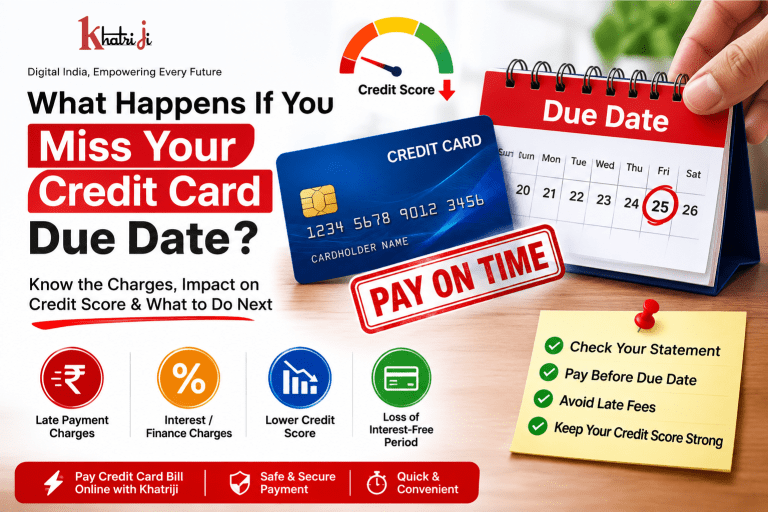
A credit card gives you the convenience of making purchases now and paying later, but every credit card bill comes with a payment due date. Missing that date can lead to additional charges, interest, loss of the interest-free period and, depending on how long the account remains unpaid, potential effects on your credit profile.
Understanding what happens after a missed payment can help you avoid unnecessary costs and manage your credit card responsibly.
In this guide, we will explain what happens if you miss your credit card due date, the difference between missing the total payment and minimum payment, late-payment charges, interest, credit reporting, and what you should do after missing a payment.
What Is a Credit Card Due Date?
The credit card due date is the date mentioned on your billing statement by which you are required to make the applicable payment.
Your statement generally shows important information such as:
- Total Amount Due
- Minimum Amount Due
- Payment Due Date
- Outstanding balance
- Applicable charges
- Payment methods
Always check your latest credit card statement because the exact due date and payment requirements are determined by your card issuer.
What Happens If You Miss Your Credit Card Due Date?
The consequences depend on your card issuer’s terms, the amount unpaid and how long the account remains past due.
Possible consequences include:
1. Late Payment Charges
Your card issuer may apply a late-payment or penal charge according to the applicable terms and conditions.
RBI rules require late-payment charges and related penal charges, where applicable, to be levied only on the outstanding amount after the due date, rather than on the entire amount due.
The actual fee depends on your credit card provider and card variant.
2. Interest or Finance Charges
If you do not pay the total amount due by the due date, you may lose the benefit of the interest-free credit period.
RBI’s FAQ explains that when the total amount due is not cleared by the due date, interest may be charged on the outstanding amount, subject to the applicable card terms.
The interest rate and calculation method can vary between credit cards.
3. Loss of the Interest-Free Period
One of the major advantages of paying your credit card bill in full is the interest-free period on eligible purchases.
If an outstanding balance remains, the interest-free benefit can be suspended according to the card’s terms. RBI requires card issuers to clearly explain this consequence to cardholders.
This means that simply paying the minimum amount should not be treated as equivalent to paying the bill in full.
What If You Pay Only the Minimum Amount?
Credit card statements generally contain both a Total Amount Due and a Minimum Amount Due.
Paying the minimum amount can help prevent the account from being treated as overdue under the applicable rules, but it does not mean that your entire bill has been paid.
The remaining balance can continue into the next billing cycle and may attract applicable interest or finance charges.
RBI specifically requires card issuers to warn customers that making only the minimum payment can extend repayment over months or years and result in consequential interest costs.
Example
Suppose your statement shows:
| Particular | Amount |
|---|---|
| Total Amount Due | ₹20,000 |
| Minimum Amount Due | ₹1,000 |
| Due Date | 25 August |
If you pay only ₹1,000, you have not cleared the ₹20,000 total bill.
The remaining amount may continue to the next billing cycle and applicable interest/charges can apply according to your card’s terms.
What If You Miss the Payment by One or Two Days?
A short delay does not necessarily have the same consequences as a long period of non-payment.
RBI’s credit-card directions state that card issuers may report an account as “past due” to credit information companies or levy penal charges only when the account remains past due for more than three days.
However, you should not intentionally rely on this three-day provision.
Your card issuer may have specific payment-processing rules, and the safest approach is to pay as soon as you realize that you have missed the due date.
What Happens If You Miss the Payment for Several Days?
If your payment remains unpaid, the consequences can become more significant.
Depending on the card issuer’s terms, you may face:
- Late-payment charges
- Interest/finance charges
- Loss of interest-free benefits
- Continued outstanding balance
- Possible credit-information reporting after the applicable period
RBI rules also state that the number of days past due and applicable late-payment charges are computed from the payment due date mentioned in the statement.
Can Missing a Credit Card Payment Affect Your Credit Score?
It can, particularly when an account is reported as past due to credit information companies.
RBI’s credit-card directions provide that issuers can report an account as past due only when it remains past due for more than three days.
The impact on your credit profile depends on factors such as:
- Whether the payment was reported
- How long the account remained unpaid
- Your previous repayment history
- The amount outstanding
- Other information in your credit report
A single short delay should not automatically be assumed to have a particular numerical impact on your credit score.
What If You Completely Forget to Pay?
If you realize that you missed your payment, don’t ignore it.
Step 1: Check Your Credit Card Statement
Confirm:
- Total Amount Due
- Minimum Amount Due
- Due Date
- Outstanding amount
- Any newly added charges
Step 2: Make the Payment as Soon as Possible
Use a payment method authorized by your card issuer.
RBI requires card issuers to provide the list of authorized payment modes on their websites and billing statements.
Step 3: Check Payment Status
After making the payment, verify whether the transaction has been successfully credited to your credit card account.
Step 4: Save the Transaction Reference
Keep your payment confirmation or transaction ID for future reference.
Step 5: Check Your Next Statement
Review the next statement to confirm that the payment and applicable charges have been correctly reflected.
How to Pay Your Credit Card Bill Online with Khatriji
If your credit card provider is supported by Khatriji, you can use the available Credit Card Bill Payment service to make your payment online.
Visit Khatriji and select the supported Credit Card Bill Payment service.
The general process is:
Step 1: Open Khatriji
Visit the official Khatriji website.
Step 2: Select Credit Card Bill Payment
Choose the Credit Card Bill Payment service.
Step 3: Select Your Card Provider
Choose the applicable supported credit card provider.
Step 4: Enter Required Details
Enter the information requested by the payment service.
Step 5: Verify Your Bill
Check the displayed bill or outstanding amount, where the service provides bill-fetch functionality.
Step 6: Complete the Payment
Choose an available payment method and complete the transaction.
Step 7: Save the Confirmation
Keep the transaction/reference number after successful payment.
Important: Always verify the card provider, card details and payment amount before confirming the transaction.
What If Your Credit Card Payment Is Successful but the Bill Still Shows as Due?
Sometimes there can be a delay between payment processing and the update of your credit card account.
If this happens:
- Check your payment status.
- Check your bank/payment account to confirm the debit.
- Keep your transaction reference number.
- Check your credit card account again after the applicable processing period.
- Contact the relevant card issuer or payment support channel if the amount remains unpaid.
Avoid making another payment immediately unless you have confirmed that the previous transaction failed.
What If Money Is Debited but Credit Card Payment Fails?
If your bank account has been debited but the credit card payment shows as failed or is not reflected:
- Do not immediately make another payment.
- Save the transaction ID.
- Check the transaction status.
- Check whether the amount has been reversed or credited.
- Contact the relevant payment/card support channel if necessary.
The transaction reference can be useful when tracking the payment.
How to Avoid Missing Your Credit Card Due Date
Prevention is easier than dealing with late charges.
Set a Reminder
Set a calendar reminder several days before the due date.
Enable Payment Notifications
Use your card issuer’s available SMS, email or app notifications.
Pay Before the Last Day
Don’t wait until the final few hours.
Keep Sufficient Balance
Make sure your selected payment account has enough funds.
Check Your Statement Regularly
Review your statement when it is generated rather than waiting for the due date.
Consider Auto-Pay
If your card issuer offers an authorized automatic payment facility, you can consider using it according to your preferences and account terms.
Total Amount Due vs Minimum Amount Due
Understanding this difference is important.
| Feature | Total Amount Due | Minimum Amount Due |
|---|---|---|
| Meaning | Full billed amount | Minimum payment specified by issuer |
| Clears entire statement balance | Yes | No |
| Remaining balance | ₹0 for the billed amount | Can remain outstanding |
| Interest-free benefit | Generally preserved when paid in full by due date, subject to card terms | May be lost |
| Best for avoiding revolving interest | Usually paying in full | Not generally |
RBI specifically requires issuers to explain the implications of paying only the minimum amount due.
Is Paying the Minimum Amount a Good Strategy?
The minimum payment can be useful when you cannot immediately pay the entire bill, but it should not become a regular repayment strategy without understanding the cost.
When you pay only the minimum:
- The remaining balance can continue.
- Interest may apply.
- Your repayment period can become longer.
- Your overall cost can increase.
RBI requires card issuers to prominently warn customers about the consequences of repeatedly making only minimum payments.
Important Tips After Missing a Credit Card Due Date
If you have missed your due date, remember these points:
Don’t panic.
First check the exact payment status.
Pay as soon as possible.
Don’t deliberately wait.
Check the charges.
Review your statement for late-payment and finance charges.
Don’t ignore the outstanding balance.
A small delay can become a larger financial issue if payments continue to be missed.
Keep payment proof.
Save transaction IDs and confirmations.
Check your credit report if necessary.
If you are concerned about reporting, review your credit information through the appropriate authorized channel.
Frequently Asked Questions
What happens if I miss my credit card due date?
Depending on your card issuer and the duration of the delay, you may face late-payment charges, interest/finance charges and loss of the interest-free period.
Will I immediately get a late payment charge after missing the due date?
RBI rules state that penal/late-payment charges can be levied when a credit card account remains past due for more than three days, and such charges apply to the outstanding amount after the due date.
Your card issuer’s applicable terms should be checked for the exact charges.
Does paying the minimum amount avoid interest?
Not necessarily. Paying the minimum amount does not clear the entire outstanding balance, and the interest-free credit period can be lost when the total amount due is not paid in full.
Can a late credit card payment affect my credit score?
It can if the account is reported as past due to a credit information company. RBI rules provide a more-than-three-day threshold for such reporting.
What should I do if I miss my payment?
Pay the outstanding amount as soon as possible, check the payment status, review any applicable charges and save the transaction confirmation.
Can I pay my credit card bill online?
Yes, credit card issuers provide authorized payment methods, which can include digital payment channels. If your provider is supported, you can also use Khatriji’s available Credit Card Bill Payment service.
Can I pay a credit card bill through Khatriji?
Yes, where the relevant credit card provider is supported by Khatriji, you can use the available Credit Card Bill Payment service.
What if my payment is pending?
Check the transaction status and whether your account was debited. Keep the transaction reference and avoid making a duplicate payment until the original transaction is resolved.
Conclusion
Missing a credit card due date can result in late-payment charges, interest or finance charges, loss of the interest-free period and potentially credit-reporting consequences if the account remains past due.
The best approach is to act quickly: check your statement, make the payment through an authorized method, verify the transaction and keep your payment confirmation.
If your credit card provider is supported, Khatriji can provide a convenient digital option for Credit Card Bill Payment.
Most importantly, don’t rely on minimum payments as a long-term strategy. Paying the total amount due on time, whenever financially possible, is generally the simplest way to avoid revolving credit-card interest and keep your payments under control.
Tags: Credit Card Bill Payment, Credit Card Bill Payment Online, Credit Card Due Date, Credit Card Interest, Credit Card Late Payment, Credit Card Late Payment Charges, Credit Card Minimum Amount Due, Credit Card Payment, Credit Card Payment Online, Digital Payment, khatriji, Missed Credit Card Payment, online bill payment, Total Amount Due